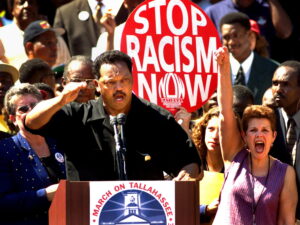
Rev. Jesse Jackson with NOW members at the March on Washington for Affirmative Action, 2000.
Rev. Jesse Louis Jackson Sr., civil rights leader, Baptist minister, and two-time presidential candidate, has died at 84. For more than five decades, Jackson stood at the forefront of movements for racial justice, voting rights, economic equity, and affirmative action, shaping national conversations about democracy and inclusion.
Jackson first rose to prominence in the 1960s as a close associate of Martin Luther King Jr., participating in voter registration campaigns and major civil rights actions across the South. Following King’s assassination, Jackson founded Operation PUSH, later merging efforts into the Rainbow PUSH Coalition, an organization dedicated to political empowerment, economic justice, and educational equity.
In the 1980s, Jackson launched historic presidential campaigns that expanded the political imagination of the Democratic Party and helped build multiracial coalitions of Black, Latino, labor, youth, and progressive voters. His campaigns emphasized what he called a “Rainbow Coalition,” foregrounding the interconnectedness of struggles against racism, poverty, militarism, and discrimination.
Jackson remained a visible and vocal advocate for affirmative action throughout his life. At the 2000 March on Washington for Affirmative Action, he stood alongside feminist leaders, labor organizers, and civil rights activists in defense of policies designed to address systemic racial inequities in education and employment. The photograph we are featuring, capturing Jackson with NOW members at that march, reflects a moment of coalition-building at a time when affirmative action faced escalating legal and political attacks.
For feminist organizations committed to racial justice, Jackson’s presence at that march underscored the shared stakes of these struggles. Affirmative action has long been critical for Black communities as well as women, working-class families, and other marginalized groups seeking equitable access to education and opportunity.
Throughout his career, Jackson used his platform to call attention to structural injustice while urging civic participation. He advocated for expanding the electorate, strengthening voting protections, addressing economic inequality, and building cross-movement solidarity.
Rev. Jesse Jackson’s life spanned the modern civil rights era, from the movement’s most dangerous years to today’s renewed backlash against equity. He carried forward a vision of democracy that required participation, accountability, and structural change.
The image from the 2000 march reminds us that feminist and civil rights struggles have long been intertwined. Defending racial justice in education and employment has always been part of the broader work of gender justice. That coalition work continues.

